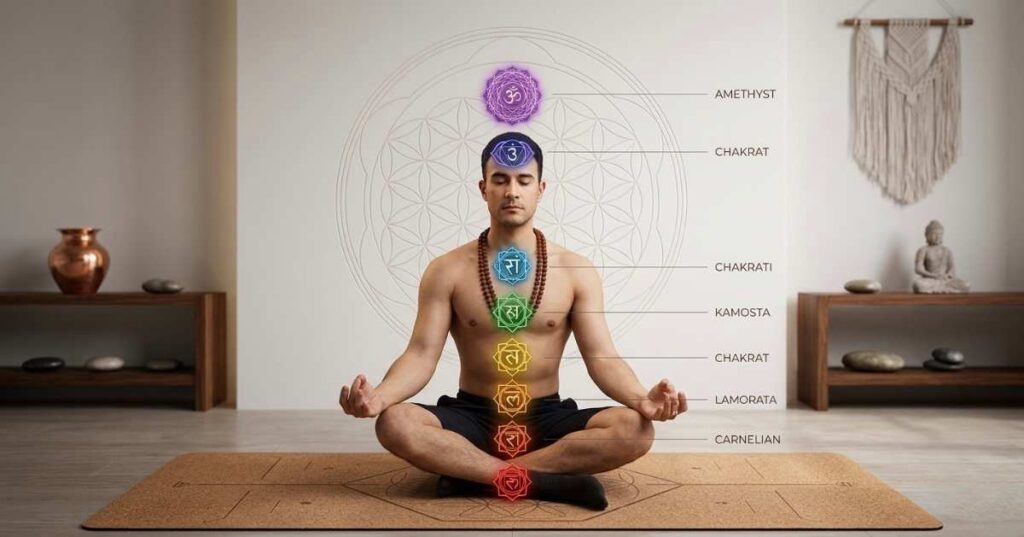
Hello, dear readers! My name is Master Ravi, and today we’re going to explore the three (Yoga’s Energy Locks) bandhas in yoga.
So, what exactly are bandhas? Think of them as internal energy locks. They help you control and direct your prana (that’s your life force) inside your body. The word bandha comes from Sanskrit and means “to lock,” “to hold,” or “to bind.” But here’s the thing – bandhas aren’t just about squeezing your muscles tightly. They’re a gentle combination of muscle engagement, breath awareness, and focused attention.
You can use bandhas in three main areas of your practice:
· Pranayama (breathwork)
· Asana (yoga postures)
· Meditation
When you softly contract certain parts of your body, you stop energy from leaking out. Instead, you guide that energy through your body’s inner channels (called nadis). The result? Better balance, more stability, and a deeper sense of inner awareness.
There are three main bandhas in yoga. Let me point them out clearly for you…
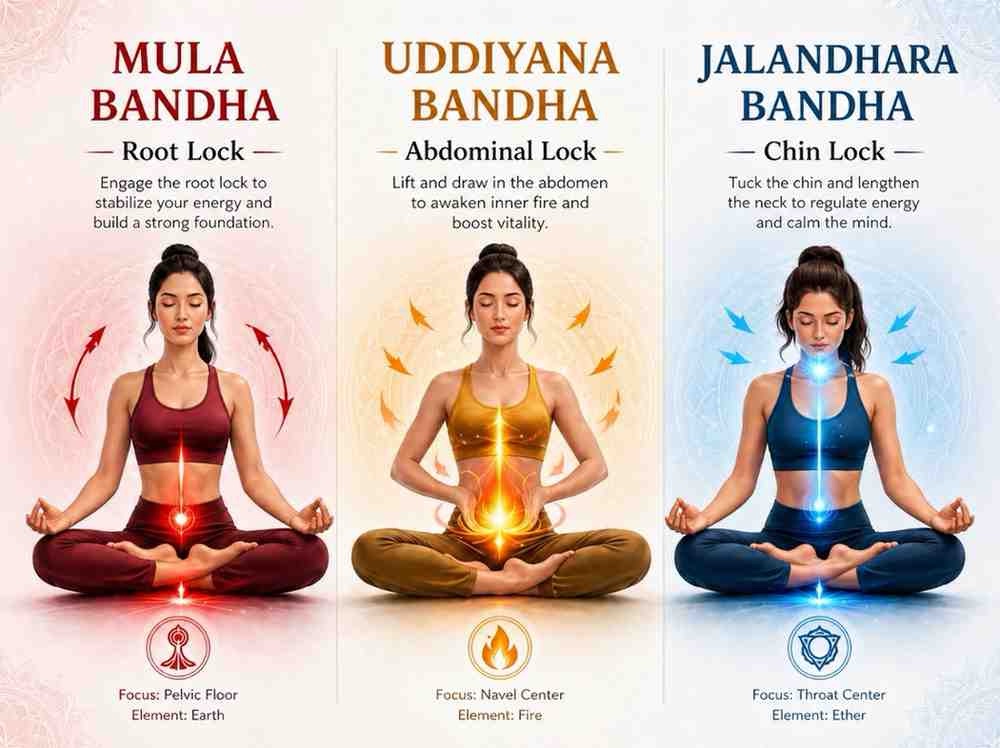
1. Mula Bandha (Root Lock) – Engaged at the pelvic floor, between the anus and genitals.
2. Uddiyana Bandha (Abdominal Lock) – Done by pulling the lower belly in and up after exhaling.
3. Jalandhara Bandha (Throat Lock) – Created by tucking the chin slightly toward the chest.
When you practice these bandhas correctly, they help you:
· Breathe better and increase lung capacity
· Build core strength and improve posture
· Stimulate your internal organs and glands
· Focus your mind and deepen meditation
Bandhas are often described as the bridge between your physical body and your energy body. They turn simple movements and breathing into a much deeper, more conscious practice. At first, they might feel very subtle, but with regular practice, they become powerful tools—not just for physical health, but for spiritual growth too.
1. Mula Bandha (Root Lock) Yoga’s Energy Locks
location–
· Primary location: The pelvic floor – the area between your pubic bone and tailbone.
How to practice mula bandha for Yoga’s Energy Locks
To practice Mula Bandha, start by sitting comfortably with your spine straight—on a chair or a cushion works fine. Take a few normal breaths to relax. Then, gently draw your attention to the area between your pubic bone and tailbone (your pelvic floor). Imagine you’re trying to stop the flow of urine midstream, but use only about 20% of the effort. Softly lift that area upward, as if you’re closing a small internal “door.” Keep your buttocks, thighs, and belly relaxed—only the deepest pelvic muscles should engage. Continue breathing normally; don’t hold your breath. Hold this subtle lift for a few seconds, then release completely. Practice for 5–10 rounds, and over time, try to keep the lift active during yoga poses or meditation. Remember: less is more. You’re looking for a gentle, quiet squeeze, not a hard clench.
Benefits-
· Improves core stability – Gives you a solid, grounded feeling in standing and balancing poses (like Tree Pose), reducing wobbliness.
· Preserves and redirects energy – Prevents vital energy (prana) from leaking downward, helping you feel less drained after practice or a long day.
· Strengthens pelvic floor muscles – Supports bladder control, aids postpartum recovery, and helps prevent pelvic floor weakness.
· Deepens your breathing – Creates gentle internal support that allows your diaphragm to move more efficiently, leading to smoother inhalations and exhalations.
· Sharpens mental focus – Acts as a physical anchor during meditation or stressful moments, calming mental chatter and increasing present-moment awareness.
· Promotes emotional stability – With regular practice, many feel more centered, grounded, and less reactive to stress.
Note- Often used in seated poses, meditation, and breathing practices.
Uddiyana Bandha (Abdominal Lock) Yoga’s Energy Locks
Location: Lower abdomen
How to Practice Uddiyana bandha –Yoga’s Energy Locks
To practice Uddiyana Bandha, start by standing or sitting with a straight spine – standing with your feet hip-width apart and knees slightly bent is easiest for beginners. Take a few deep breaths to relax. Then, exhale completely and forcefully through your mouth, emptying your lungs entirely. Without inhaling, gently pull your belly button inward and upward toward your spine, as if you’re trying to stick your belly to the back of your rib cage. You’ll notice a hollow shape forming under your ribs – that’s the lock. Hold this contraction for a few seconds (only as long as comfortable), then release your belly, relax, and take a slow, controlled inhale. Rest for a few breaths before repeating. Important: Always practice on an empty stomach (wait 3–4 hours after a meal), and never do it if you’re pregnant, have a hernia, high blood pressure, or any abdominal surgery. Start with 3–5 rounds and go slowly. Less is more – you’re creating a gentle vacuum, not straining.
Benefits
· Massages internal organs – Gently compresses and lifts the stomach, liver, pancreas, kidneys, and intestines, improving their function and circulation.
· Stimulates digestion – Helps relieve constipation, indigestion, and bloating by activating the digestive fire (Agni).
· Strengthens the diaphragm – Improves its range of motion, supporting deeper and more controlled breathing.
· Tones deep core muscles – Works the transverse abdominis, helping flatten the belly and support lower back health.
· Boosts energy and alertness – The vacuum action stimulates the solar plexus (Manipura chakra), leaving you feeling refreshed and mentally clear.
· Supports detoxification – Aids the lymphatic system and venous return, helping remove stagnant blood and waste from abdominal organs.
· Enhances pranayama practice – Prepares the lungs and diaphragm for breath retention (kumbhaka) and other advanced breathing techniques.
· Reduces abdominal tension – Releases chronic tightness in the belly caused by stress or poor posture.
Note- Best practiced on an empty stomach and typically after exhalation.
Jalandhara Bandha (Throat Lock)
Location: Throat/neck
How to practice of Jalandhara Bandha
To practice Jalandhara Bandha, sit comfortably in a cross-legged position or on your heels (Vajrasana) with your spine straight and your hands resting on your knees. Take a few normal breaths to settle in. On an exhale, gently lengthen the back of your neck. Then, without straining, lower your chin slightly and tuck it inward toward your chest, as if you’re trying to touch your chin to your collarbone or the hollow of your throat. Keep your shoulders relaxed and your chest open – don’t round forward. At the same time, gently lift your sternum (breastbone) slightly, so the throat lock feels soft and controlled, not crushed. You can hold this lock while practicing breath retention (after an inhale or exhale). To release, simply lift your chin back to neutral and breathe normally. Important: Never force the chin down if you have neck injuries or high blood pressure. Start with a very gentle tuck – about 50% of your full range – and only hold for a few seconds until you’re comfortable. The key is a soft, sealing sensation at the throat, not a hard pinch.
Benefits
· Regulates blood flow to the brain – The gentle compression on the carotid sinuses helps balance blood pressure and calms the nervous system.
· Slows heart rate – Activates the vagus nerve, promoting relaxation and reducing anxiety.
· Improves thyroid function – Stimulates the thyroid and parathyroid glands, which regulate metabolism, energy, and calcium balance.
· Blocks upward-moving energy – Prevents prana from escaping out of the throat and head, redirecting it down the spinal channel (sushumna) for deeper meditation.
· Deepens breath retention – Essential in pranayama (especially Kumbhaka) because it locks the air in the lungs, allowing longer, more comfortable holds.
· Quiets mental chatter – The chin lock creates a physical feedback loop that reduces the “monkey mind” and supports meditative states.
· Relieves tension in neck and shoulders – When done softly, it stretches the back of the neck and releases chronic tightness.
· Supports other bandhas – Works together with Mula and Uddiyana Bandha (the “Grand Lock” or Maha Bandha) to direct energy through the chakras.
Note: Avoid if you have neck injuries, high blood pressure, heart disease, or increased intracranial pressure. Practice gently and never force the chin down. Always keep breathing – don’t lock the throat so tight that you can’t swallow or breathe at all.
FAQ
What’s the difference between Mula Bandha and a Kegel exercise?
This is a very common point of confusion. While they engage similar muscles (the pelvic floor), a Kegel is a purely physical exercise to strengthen muscles, often used to improve bladder control. Mula Bandha is an energetic lock.
· Kegels focus only on the physical contraction and release to build muscle tone.
· Mula Bandha uses a gentle, sustained lift to seal and direct energy (prana) upward. It’s practiced in conjunction with the breath (often held) during pranayama and asana to circulate life force, not just to strengthen a muscle group.
Is it safe to practice Uddiyana Bandha? What are the risks?
Uddiyana Bandha is a more advanced practice that requires caution. Because it involves a powerful “vacuum” in the abdomen, it should never be practiced on a full stomach. You should wait at least 3-4 hours after a full meal. Due to the intense internal pressure, Uddiyana Bandha is not safe for pregnant women, anyone with high blood pressure, heart disease, ulcers, hernias, or recent abdominal surgery. Always practice gently and learn from a qualified teacher.
Can bandhas really improve my meditation?
Absolutely. For many, this is one of the primary reasons to practice bandhas. Physically, they help you maintain a steady seated posture. Energetically, they seal and redirect prana upward, which calms mental restlessness (the “monkey mind”) and promotes deep focus. By stopping the dissipation of energy, bandhas help turn your awareness inward, creating the ideal internal environment for meditation. Many yogis find that bandhas help them achieve states of inner harmony, balance, and even joy more quickly.
Which bandha should I learn first?
For most beginners, Mula Bandha is the best place to start. It’s the foundation of the entire energetic system, located at the base of the pelvis. Learning the subtle engagement of the Root Lock first creates a stable foundation of awareness that you can then build upon. Trying to learn Uddiyana Bandha without first understanding the lift and stability of Mula Bandha can be difficult. Start by mastering the gentle lift of the pelvic floor in seated postures, then move on to the more complex abdominal lock.
How long does it take to see results from practicing bandhas?
You can feel the immediate effects of bandhas right away. Most people notice a sense of core stability, centeredness, and mental focus as soon as they successfully engage a lock. The long-term benefits, such as improved energy flow, better digestion (from Uddiyana Bandha), and balanced thyroid function (from Jalandhara Bandha), develop with consistent practice over weeks or months. Like any subtle, energetic practice, the results deepen over time, becoming more powerful tools for both physical health and spiritual growth.
Can I practice bandhas during pregnancy?
Generally, Mula Bandha is considered safe and is often recommended during pregnancy to strengthen the pelvic floor in preparation for childbirth. However, it should be practiced very gently and without breath retention. Uddiyana Bandha and Maha Bandha are strictly contraindicated during pregnancy because of the intense pressure they create in the abdominal cavity. Always consult with your healthcare provider and an experienced prenatal yoga instructor. A gentle, modified approach to Mula Bandha is best, and the other bandhas should be avoided entirely until after you have fully recovered postpartum.