
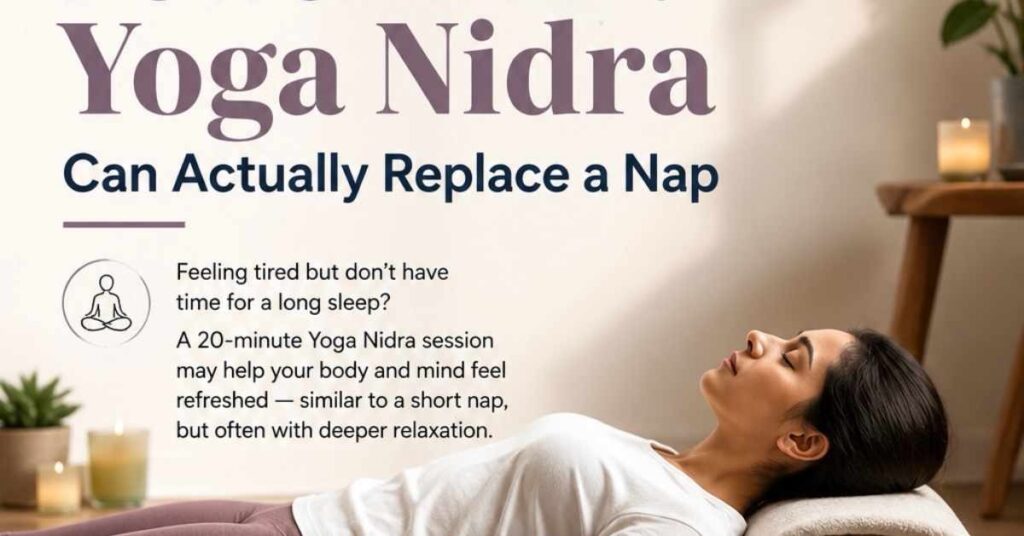
Yoga Nidra- We’ve all been there: it’s 3:00 PM, your brain feels like wet cardboard, and you’re debating whether a 20‑minute nap will leave you refreshed or feeling like you’ve been hit by a freight train. Enter Yoga Nidra. Often called “yogic sleep,” this ancient practice is trending in the modern wellness world as the ultimate productivity hack. But can a 20‑minute session truly replace a traditional nap? Let’s dive into the science of deep rest. Here’s the short answer: for most afternoon slumps, yes—because Yoga Nidra doesn’t just rest your body; it actively resets your nervous system.
While a nap risks waking up groggy (thanks, sleep inertia), a guided 20‑minute Yoga Nidra session keeps your mind gently aware while your brain slips into the restorative delta waves normally reserved for deep sleep. The result? You pop up clear‑headed, not foggy, with lower cortisol and sharper focus—no alarm-clock dread required.
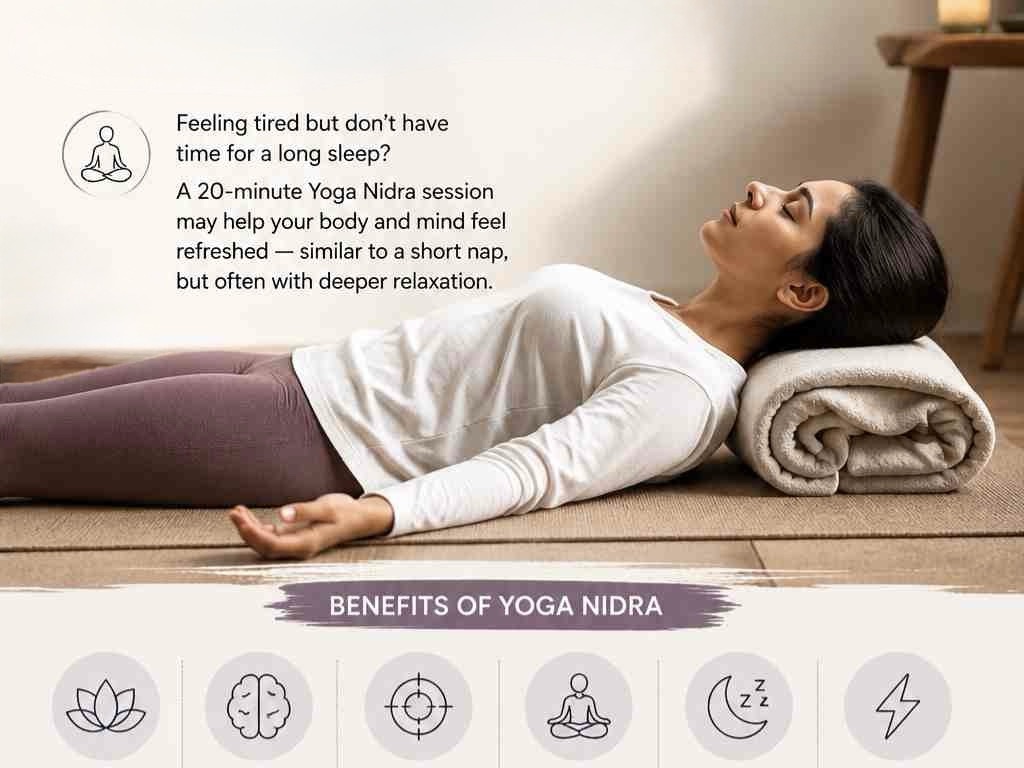
What is Yoga Nidra?
Unlike a standard yoga class, there are no downward dogs here. Yoga Nidra is a guided meditation practiced lying down. It systematically leads you through the layers of self—from physical sensation to breath awareness—aiming to land you in the “liminal space” between wakefulness and sleep. In that threshold, something remarkable happens: your body sinks into profound rest, your muscles release, and your heart rate slows, yet your mind remains softly aware. You’re not trying to focus, empty your thoughts, or stay awake; you’re simply following the voice as it walks you through a body scan, a breath awareness, or a brief visualization.
The result is a state often described as deeper than sleep itself—because while your brain generates delta waves (normally reserved for the deepest stage of non‑REM sleep), you never lose consciousness. This is why a 20‑minute session can feel as restorative as two hours of actual sleep, and why many leave a Yoga Nidra practice saying, “I didn’t think I was sleeping, but I feel completely rebuilt.”
The Magic of the “Hypnagogic State”
So here’s what’s actually happening in that fuzzy in-between space: your body is completely limp and relaxed—like, melt-into-the-floor relaxed—but your mind is still awake enough to notice it. You haven’t checked out. And that’s the whole trick. Because when you’re in this spot, your nervous system flips into “rest and digest” mode (fancy term: parasympathetic). That’s the same setting your body uses for deep healing and recovery. The difference? Normally you’d have to be fully asleep to get there. With Yoga Nidra, you get all those benefits without actually losing consciousness. Pretty wild, right?
The Science: Yoga Nidra vs. Napping
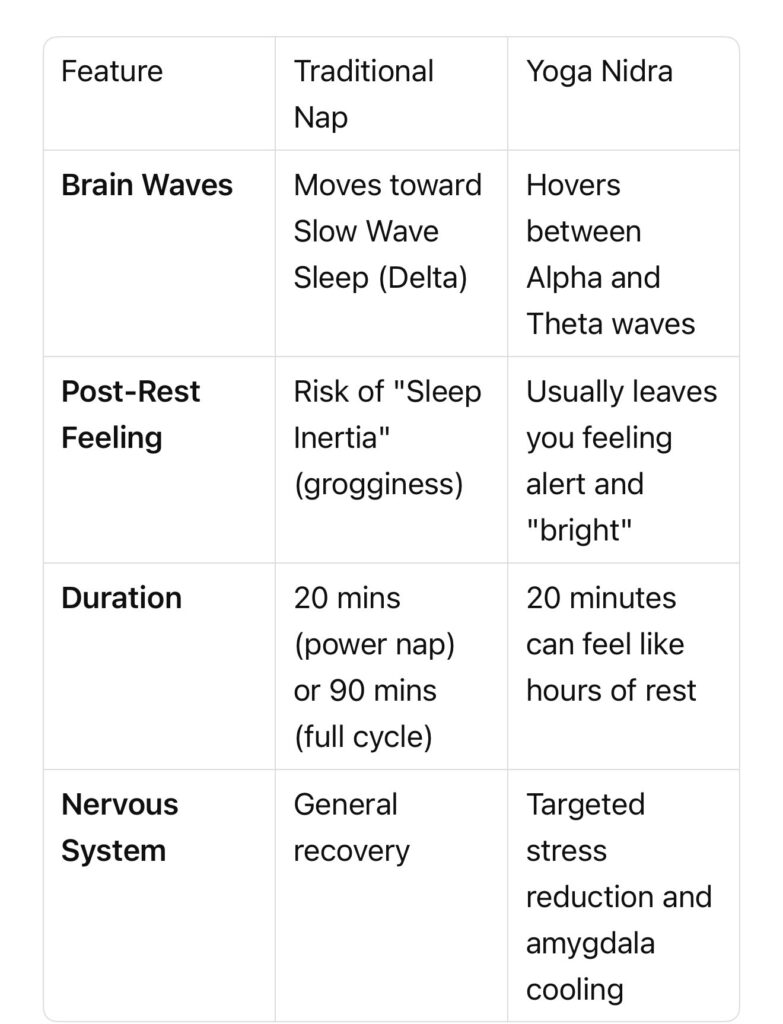
While a nap is a physical “shutdown,” Yoga Nidra is a conscious “rewiring.” Here is how they stack up:
Why 20 Minutes Feels Like 2 Hours
Okay, so you’ve probably heard people say that 20 minutes of Yoga Nidra is just as good as two hours of sleep. I’m gonna be real with you—that’s not literally true. You still need your eight hours at night. But here’s why the rumor started: on a brain chemistry level, this practice works fast. It can slash your cortisol (that’s your stress hormone) and nudge your dopamine up by as much as 65%, according to some studies. That’s a pretty big mood and energy boost in just 20 minutes.
Plus, because you’re not actually falling into a full sleep cycle, you skip that awful groggy “what year is it?” feeling you get when you wake up mid-nap. Instead, you pop up clear-headed and ready to go. So while it’s not a replacement for real sleep, it’s definitely a cleaner, smarter energy reboot than a risky afternoon nap.
How to Try It Today
You don’t need a fancy studio or any special equipment. Honestly, if you’ve got 20 minutes and a patch of floor, you’re good to go. First, make yourself a little nest: lie on your back—that’s Savasana if you want to be fancy—and tuck a pillow under your knees, then throw a blanket over yourself. Your body temperature will actually drop as you relax, so the blanket isn’t just for comfort. Next, grab a guide. Your brain will want to wander off and make grocery lists, so don’t try to do this solo at first.
Fire up an app or a YouTube track—search for something like “20 minute Yoga Nidra for energy.” Then comes the slightly tricky part: stay still. Like, really still. The idea is that when your body stops fidgeting, your mind stops sending all that physical “chatter” and finally gets the hint to settle down. And most sessions will ask you to set a Sankalpa—basically a simple intention you silently repeat to yourself. Think of it as planting a little seed in your subconscious while you’re in that super‑receptive, dreamy state. No pressure, no perfection. Just lie down, press play, and see what happens.
The Verdict: Can It Replace a Nap?
Look, here’s my honest take. If you’re just trying to shake off that 3 PM brain fog and calm down a nervous system that’s been running on caffeine and anxiety all day? Yeah, Yoga Nidra is probably better than a nap. No nap hangover, no waking up confused about what century it is. You get clean, clear energy.
But—and this is a big but—if you’re truly sleep‑deprived? Like, running on four hours and a prayer? Nothing, and I mean nothing, replaces actual REM and deep sleep. That’s when your body does the real repair work. So don’t toss your bed out the window.
Think of Yoga Nidra as your secret weapon for daily maintenance. It’s the tune‑up, the quick reset. Your bed? That’s where the heavy lifting happens. Use both, and you’ll feel like a human being again.
FaQ
Q: Is Yoga Nidra the same as meditation?
Actually, not exactly. While they share the goal of calming the mind, Yoga Nidra is more like a specific, guided “power-down” for your entire system. In traditional meditation, you’re usually seated and actively training your focus, often on your breath or a mantra. In Yoga Nidra, you lie down and a voice guides you through a body scan and other steps. You’re not trying to concentrate; you’re just following along, allowing yourself to drift into a state of deep, conscious relaxation. Think of meditation as actively training your mind, while Yoga Nidra is passively guiding it into deep rest.
Q: What’s the difference between Yoga Nidra and sleeping? Am I supposed to fall asleep?
Answer: Great question. The goal isn’t to fall unconscious. The magic of Yoga Nidra is staying in a state of “dynamic sleep”—your body is completely relaxed, but your awareness remains alert. As one expert puts it, “The difference between deep sleep and yoga nidra is that in yoga nidra we stay 100 percent alert and awakened”. If you doze off, it’s not a failure! But with practice, you’ll learn to walk the line between sleep and wakefulness, which is where the deep restoration happens.
Q: Can Yoga Nidra replace my sleep or my afternoon nap?
Answer: It’s an incredible tool, but it has limits. For a quick afternoon reboot, yes, 20 minutes of Yoga Nidra can be far more effective than a nap. You wake up clear-headed, not groggy. However, if you’re chronically sleep-deprived, it is not a substitute for the essential physiological repair that happens during a full night’s REM and deep sleep. TLDR: It’s a brilliant energy reset, but not a replacement for your bed.
Q: What are the proven benefits of Yoga Nidra? Does the science back it up?
Answer: Absolutely. The research is growing and very promising. Studies show it can rapidly reduce cortisol (the stress hormone), shift your nervous system into “rest and digest” mode, and significantly improve sleep quality. There is also compelling evidence that it helps with anxiety and even chronic pain, which is why it’s been used by the U.S. Army for soldiers recovering from stress disorders.
Q: How is Yoga Nidra different from NSDR (Non-Sleep Deep Rest)?
Answer: This is a modern, trendy question! Essentially, NSDR is a broader term popularized by neuroscientist Andrew Huberman to describe any practice that induces deep rest without actual sleep. Think of NSDR as the category, and Yoga Nidra is the original, ancient practice that fits perfectly inside it. So, they are very similar, but Yoga Nidra has a specific, traditional structure and language.
Q: Is Yoga Nidra like hypnosis?
Answer: No, it’s different. In hypnosis, the goal is often to make you highly suggestible for specific behavior changes. In Yoga Nidra, you are guided into a state of deep relaxation and self-awareness, but you remain fully in control and aware at all times. You aren’t being programmed; you’re being given the space to rest and reconnect with yourself.
Q: How long does a Yoga Nidra session usually last?
Answer: Most guided sessions last between 20 to 45 minutes. A 20-minute practice is considered the “power-play” sweet spot for a quick mental reboot and clarity boost. However, a full 30- or 40-minute session will take you through all the traditional stages, providing an even deeper level of restoration.
Q: Do I need to prepare in any way? Do I need to do yoga poses first?
Answer: The best part: you don’t need any preparation. Unlike a physical yoga class, there are no down-dogs required. You can simply lie down on your back (you can use pillows under your knees and head for comfort), close your eyes, and press play on a guided track.
Q: Are there any side effects or people who shouldn’t do Yoga Nidra?
Answer: For the vast majority of people, it’s extremely safe and has no side effects. Some people may experience involuntary muscle twitches or feel emotional as deep-seated stress is released, which is totally normal. Generally, it is considered safe for most people, but caution is advised for those with severe, unmanaged mental health conditions. In such cases, it’s always best to consult with a doctor or therapist before beginning.
Q: How often should I practice Yoga Nidra to see benefits?
Answer: Even one session can make you feel profoundly relaxed. However, to see lasting changes in sleep, stress, and focus, consistency is key. Many experts recommend practicing for 10-20 minutes every day. A famous piece of advice is to practice daily for 40 days with the same intention to truly see how it transforms your mindset. Even just 2-3 times a week will provide immense benefits.
Q: What is a “Sankalpa”? I keep seeing that word.
Answer: Sankalpa” is a Sanskrit word that means “intention” or “resolve.” It’s a short, positive, present-tense statement you set for yourself at the beginning and end of the practice. Think of it like a seed you’re planting in the fertile soil of your subconscious while you’re deeply relaxed. An example might be, “I am calm,” “I am healthy,” or “I am focused.
Pingback: 5 Yoga Poses Before Going to Bed for Better Sleep - Anama Yoga